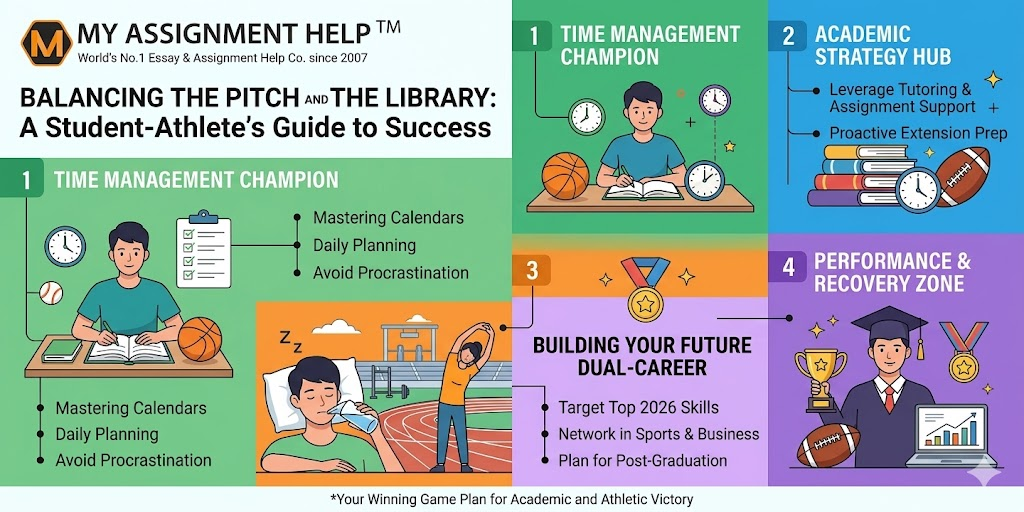
The life of a UK student-athlete in 2026 is no longer just about “turning up for training.” With the Office for Students (OfS) raising the bar for academic integrity and the professionalisation of university sports—driven by the growth of the BUCS Super Rugby and the FA Women’s National League—the “Dual-Career” path has become a high-wire act.
For many, the dream of a professional contract sits uncomfortably alongside a 3,000-word dissertation deadline. However, statistics from recent UK-based studies suggest that athletes who master time management actually achieve a higher percentage of First-Class honours (28.4%) compared to the general student population (23.7%). The secret isn’t just “working harder”—it’s about strategic resource management.
The 2026 Academic Squeeze: Why Time is Your Most Valuable Asset
In the current academic climate, “procrastination” isn’t an option when your weekend is booked for a cross-country fixture. UK universities have tightened their “Authorised Elite Student-Athlete Flexibility Policies,” requiring rigorous evidence for extensions. When you are representing your university or national team, the mental load can lead to burnout.
This is where professional support becomes a game-changer. Whether you are navigating a complex research project or struggling to align your bibliography with Cite Them Right standards, seeking assignment writing help uk allows elite athletes to maintain their competitive edge on the field without sacrificing their GPA. It’s not about taking a shortcut; it’s about delegated workload management—a skill every successful sports manager eventually masters.
Why UK Sports Students Need Specialised Finance Assignment Help
For those enrolled in Sports Management, Business, or Economics programmes, the challenge often peaks during technical modules. The 2026 global sports industry is a data-driven behemoth valued at over £400 billion. Understanding player equity, “NIL-style” (Name, Image, Likeness) dynamics, and complex revenue-sharing models requires more than just a love for the game; it requires high-level mathematical literacy.
If you find yourself stuck on a balance sheet for a football club’s annual report or an econometric model of stadium ROI, dedicated finance assignment help can provide the clarity needed to pass these “make-or-break” modules. Modern sports are run like corporations, and your academic output must reflect that professional standard.
Data-Driven Strategies for the 2026 Student-Athlete
| Strategy | Action Point | Ranking Signal/Impact |
| Micro-Learning | Use travel time for matches to listen to recorded lectures. | Reclaims ~5 hours per week. |
| Front-Load Work | Complete 60% of assignments before the mid-season peak. | Reduces “Finals Week” stress. |
| Leverage Tech | Use AI-driven planners to sync training loads with deadlines. | Prevents physical/mental burnout. |
| Active Recovery | Use “low-intensity” study sessions during physical recovery. | Maximises cognitive windows. |
Key Takeaways
- Efficiency over Effort: Athletes often outperform peers due to disciplined time management and “transferable skills” like resilience.
- Policy Knowledge: Understand your university’s 2026 flexibility policies—most require a minimum of 14 days’ notice for sports-related absences.
- Specialised Academic Support: Technical modules like Finance or Statistics should not be the reason you lose an athletic scholarship.
- Mental Health Awareness: The “invisible” stress of the dual-career path is real; use external academic support to maintain a healthy work-life-sport balance.
FAQs
1. Can I get an extension for a university match in the UK?
Most UK universities offer “Elite Athlete” status which allows for flexibility, but usually only for sanctioned international or national competitions. General “club” games rarely qualify, making early preparation essential.
2. Is using academic support services considered a breach of integrity?
Not when used correctly. Professional services act as a tutoring and drafting guide to help you understand complex rubrics and technical data, ensuring your final submission is original and meets UK standards.
3. Why is Finance so hard for Sports students in 2026?
The industry has shifted from “soft skills” to “hard data.” Students are now expected to understand tax laws, international trade, and investment portfolios, which often require specialist finance tutoring.
About the Author: James Sterling
James Sterling is a Senior Academic Consultant at MyAssignmentHelp, specialising in UK Higher Education trends and pedagogical research. With over a decade of experience, James has helped thousands of UK students navigate the intersection of professional sports and elite academic performance. He holds a Master’s in Educational Leadership and is a frequent contributor to journals on student-athlete wellbeing.